Chronological Overview

Egyptian Historical Periods

Egyptian history spans approximately 3,000 years from the first Pharaonic unification around 3100 BCE to the Roman conquest in 30 BCE — and continues through Ptolemaic, Roman, Byzantine, Islamic and Ottoman periods to the modern day. Understanding the period of a monument is inseparable from understanding what you are looking at: a tomb from 2650 BCE and a temple from 250 BCE were built in entirely different political, theological and artistic contexts, even though both are Pharaonic.

Master Chronology

The Periods of Ancient Egypt

The periodisation system below follows the standard Egyptological framework established by Manetho and refined by modern scholarship. All dates are approximate and subject to ongoing revision as new evidence is published.

Period Approximate Dates Dynasties Key Monuments Capital
Pre-Dynastic c. 5000–3100 BCE Hierakonpolis, Naqada sites Various
Early Dynastic c. 3100–2686 BCE 1–2 Abydos royal tombs (Umm el-Qa'ab) Memphis / Thinis
Old Kingdom c. 2686–2181 BCE 3–6 Giza Pyramids, Saqqara, Dahshur Memphis
First Intermediate Period c. 2181–2055 BCE 7–10 Herakleopolis, Theban tombs Herakleopolis / Thebes
Middle Kingdom c. 2055–1650 BCE 11–12 Karnak (early), Lahun Pyramid Thebes / Itjtawy
Second Intermediate Period c. 1650–1549 BCE 13–17 Avaris (Tell el-Dab'a) Avaris / Thebes
New Kingdom c. 1549–1069 BCE 18–20 Valley of Kings, Karnak, Abu Simbel, Amarna Thebes / Pi-Ramesses
Third Intermediate Period c. 1069–664 BCE 21–25 Tanis royal tombs, Bubastis Tanis / Bubastis
Late Period 664–332 BCE 26–30 Saqqara Late Period tombs, Edfu (begun) Sais / Memphis
Ptolemaic Period 332–30 BCE Macedonian + 31–Ptolemaic Edfu, Dendera, Kom Ombo, Philae Alexandria
Roman and Byzantine Egypt 30 BCE–641 CE Esna hypostyle hall, Coptic monuments Alexandria
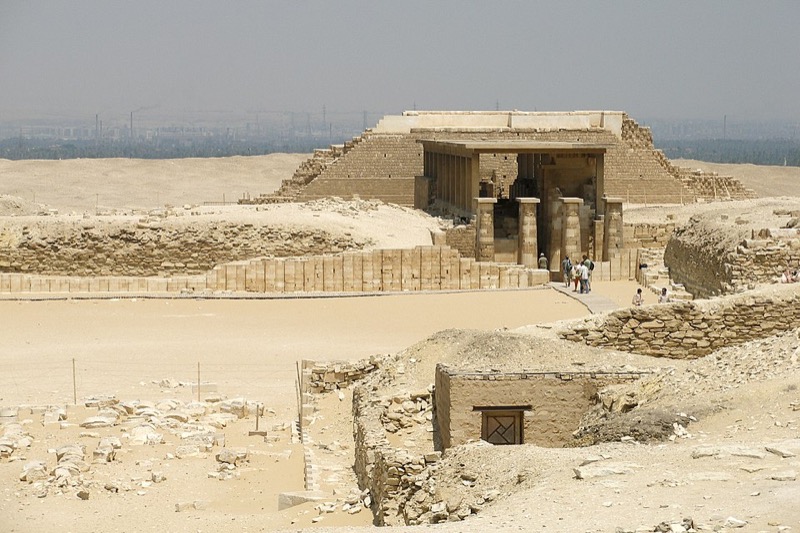
Step Pyramid of Djoser at Saqqara, the defining monument of the Old Kingdom
c. 2686–2181 BCE

The Old Kingdom: The Age of Pyramids

The Old Kingdom, covering the Third through Sixth Dynasties, is the period that produced the most immediately recognisable monuments of ancient Egypt: the Giza pyramids, the Step Pyramid at Saqqara, the Dahshur pyramids of Sneferu, and the hundreds of mastaba tombs that populate the Memphis necropolis from Giza south to Meidum. The defining theological concept of the period was divine kingship — the pharaoh as the earthly embodiment of the god Horus, and upon death as the god Osiris — expressed architecturally in the pyramid as a royal tomb of cosmic significance.

The Third Dynasty pharaoh Djoser (c. 2650 BCE) and his architect Imhotep initiated the tradition of monumental stone construction with the Step Pyramid at Saqqara. The Fourth Dynasty then produced the most ambitious building programme in human history in rapid succession: Sneferu built three large pyramids at Meidum and Dahshur (including the Bent Pyramid and the Red Pyramid — the first true pyramid); his son Khufu built the Great Pyramid at Giza; Khufu's son Khafre built the second Giza pyramid and is attributed with commissioning the Great Sphinx; Menkaure completed the third Giza pyramid. This sequence of construction, spanning roughly a century, has never been repeated in scale or ambition.

The Old Kingdom collapsed around 2181 BCE following a combination of prolonged drought (documented in Egyptian administrative texts and confirmed by Nile flood level records at Elephantine), provincial decentralisation and — possibly — the extraordinary duration of the Sixth Dynasty pharaoh Pepi II's reign, reputedly 94 years, during which central authority atrophied. The First Intermediate Period that followed was characterised by provincial autonomy, literary elegies describing social collapse, and a radical democratisation of funerary religion that had previously been restricted to royalty. For the physical remains of this period, see our monuments guide and the Saqqara excavation overview.

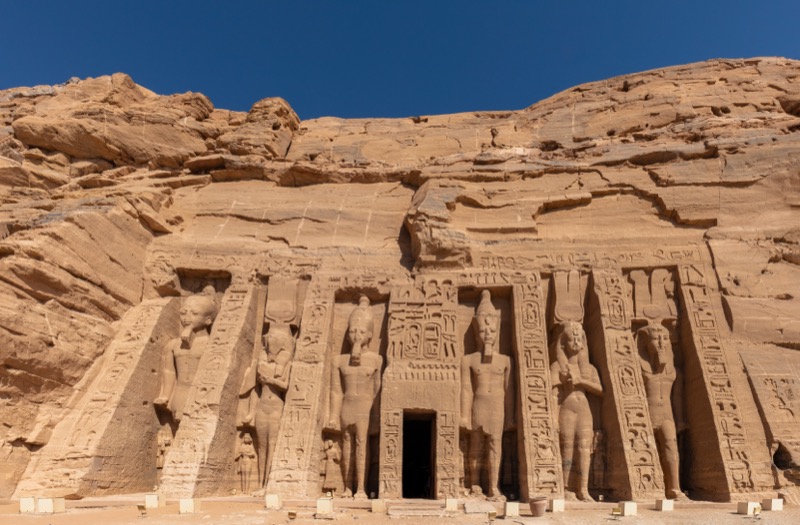
The four colossal statues of Ramesses II on the facade of Abu Simbel's Great Temple
c. 1549–1069 BCE

The New Kingdom: Imperial Egypt at Its Height

The New Kingdom — the Eighteenth, Nineteenth and Twentieth Dynasties — represents the political, military and artistic apex of Pharaonic civilisation. The expulsion of the Hyksos (a Semitic ruling group who had controlled northern Egypt during the Second Intermediate Period) by the Theban pharaoh Ahmose I in approximately 1549 BCE established a militarised state that expanded into Palestine, Syria, Nubia and Libya, creating Egypt's first territorial empire.

The Eighteenth Dynasty produced the most celebrated individual rulers in Egyptian history: Hatshepsut, who ruled as female pharaoh for over 20 years and whose mortuary temple at Deir el-Bahri is among the most architecturally elegant buildings of the ancient world; Thutmose III, her successor and one of history's most successful military commanders (17 campaigns in the Levant); Amenhotep III, whose peaceful reign was marked by extraordinary building activity including Luxor Temple and the colossal statues known as the Colossi of Memnon; and Akhenaten, whose religious revolution disrupted the tradition sufficiently to warrant his exclusion from the official king lists compiled by later rulers.

The Nineteenth Dynasty pharaoh Ramesses II (c. 1279–1213 BCE), who reigned for 67 years, is the most physically present ruler in Egypt's surviving monuments: Abu Simbel, the Ramesseum (his mortuary temple on the Luxor West Bank), the Battle of Kadesh inscriptions at Karnak and Abydos, the Osireion, and dozens of statues, obelisks and inscriptions across the country. He is almost certainly the historical figure who inspired the biblical Exodus narrative, though the scholarly evidence for this identification is contested.

The New Kingdom ended with the fragmentation of royal authority following the reign of Ramesses XI (the last Twentieth Dynasty ruler) and the division of Egypt between a High Priest of Amun ruling Upper Egypt from Thebes and a pharaoh controlling Lower Egypt from Tanis. See our Nile Valley guide for the physical geography of New Kingdom heritage sites.
332–30 BCE

The Ptolemaic Kingdom: Greek Pharaohs and Egyptian Temples

When Alexander the Great entered Egypt in 332 BCE and was recognised as pharaoh at Memphis, he initiated a three-century period during which Egypt was ruled by a Macedonian Greek dynasty that adopted Pharaonic titles, supported the temple system and built some of the most lavishly decorated temples in Egyptian history — while conducting the administration of a Hellenistic kingdom and making Alexandria the intellectual capital of the Mediterranean world.

Ptolemy III — Euergetes

The Temple Builders

The major Ptolemaic building programme began under Ptolemy III Euergetes (reigned 246–222 BCE) and continued through the dynasty's 300-year tenure. The temples at Edfu (begun 237 BCE), Kom Ombo (begun c. 180 BCE), Dendera (Hathor temple, begun 54 BCE) and the expansion of Philae were all initiated or substantially completed by Ptolemaic rulers who presented themselves in traditional Pharaonic iconography on the temple walls despite conducting their private lives in Greek. The result is a body of temples built with Ptolemaic resources and Hellenistic precision but decorated in the most elaborately conservative Pharaonic style — a deliberate cultural performance intended to demonstrate legitimacy to the Egyptian priestly class and population.

Ptolemaic monuments →
Alexandria — The Intellectual Capital

The Mouseion and Great Library

The Mouseion of Alexandria, established under Ptolemy I Soter and developed by Ptolemy II Philadelphus in the early 3rd century BCE, was the ancient world's premier research institution — a combination of university, research centre and library funded by royal patronage. Its Great Library reportedly held between 400,000 and 700,000 scrolls, including works acquired or copied from across the known world. Scholars working there included Euclid (geometry), Eratosthenes (who calculated the circumference of the earth to within 2% accuracy using shadow measurements at Syene/Aswan and Alexandria), Archimedes, Callimachus and Hypatia. The library was damaged in Julius Caesar's Alexandrian campaign of 48 BCE and declined gradually thereafter; it was not destroyed in a single dramatic fire as popular legend suggests.

Alexandria overview →
Cleopatra VII — Last Pharaoh

The End of Pharaonic Egypt

Cleopatra VII (reigned 51–30 BCE) is the most famous of all Ptolemaic rulers and the last native ruler of Egypt before Roman annexation. Unlike her Ptolemaic predecessors, she was reportedly the first of the dynasty to learn the Egyptian language (in addition to eight others), and she presented herself to the Egyptian population as a living embodiment of Isis. Her political alliances with Julius Caesar and Mark Antony were attempts to preserve Egyptian independence against Roman power; when Octavian (later Augustus) defeated Antony at the Battle of Actium in 31 BCE, Cleopatra committed suicide rather than walk in chains in a Roman triumph. Egypt became a Roman province in 30 BCE. Her image survives on temple reliefs at Dendera.

Museum collections →
Chronology Questions

Historical Periods FAQ

The conventional beginning of Egyptian civilisation is placed at the unification of Upper and Lower Egypt under the First Dynasty pharaoh Narmer around 3100 BCE. However, the foundations were laid during the Pre-Dynastic period (c. 5000–3100 BCE), when complex agricultural societies, writing precursors and hierarchical political structures were developing across the Nile Valley. The Narmer Palette, now in the Cairo Museum, is the earliest known example of the complete Egyptian royal iconographic programme and dates to this unification moment. Pre-Dynastic sites such as Naqada, Hierakonpolis and Abydos's Umm el-Qa'ab are archaeologically accessible but less often visited than the Pharaonic monuments.

Ancient Egypt is divided into 30 or 31 dynasties by Egyptologists (depending on the scholarly convention), running from approximately 3100 BCE to 332 BCE when Alexander the Great ended the last native Egyptian dynasty. The Ptolemaic rulers (332–30 BCE) are sometimes counted as a 32nd dynasty. The dynastic system was established by the Egyptian priest-historian Manetho in the third century BCE in his Aegyptiaca, written for Ptolemy II Philadelphus — ironically, a Greek pharaoh commissioning a history of Pharaonic Egypt. Roman Egypt (30 BCE–395 CE) and Byzantine Egypt (395–641 CE) are generally considered post-Pharaonic but are part of the continuous archaeological and cultural record studied by Egyptology.

The collapse of the Old Kingdom was multi-causal. Sediment core analysis from the Nile and isotopic data from speleothems in the Sinai confirm a prolonged drought across northeast Africa and the Near East beginning around 2200 BCE (the so-called 4.2 kiloyear event). Contemporary Egyptian administrative texts and tomb autobiographies describe failed floods, famine, political disorder and migration. The decentralisation of power to provincial governors (nomarchs) over the course of the Sixth Dynasty — a process that Pepi II's exceptionally long reign (c. 64–94 years, still debated) may have accelerated — meant the royal state lacked the administrative coherence to respond to climate stress. The result was fragmentation rather than sudden collapse.

The shift from pyramid to rock-cut tomb, which occurred at the beginning of the New Kingdom under Thutmose I (c. 1504 BCE), was deliberate and strategic. The pyramid's visibility made it an obvious target for tomb robbery — a problem that had plagued Old and Middle Kingdom royal burials despite elaborate physical protections. The hidden rock-cut tomb in the remote Valley of the Kings was intended to protect the royal burial through secrecy rather than monumentality, supported by a dedicated guard force. The strategy was only partially successful: virtually all Valley of the Kings tombs were robbed in antiquity, most during the Third Intermediate Period when the state could no longer maintain security. Only Tutankhamun's tomb remained intact until 1922, partially because it had been sealed beneath debris from a later tomb and forgotten.

Egypt's relationship with Nubia — the region south of the First Cataract at Aswan — oscillated across three millennia between trade partner, tribute-paying vassal and full conquest. During the New Kingdom, Egypt controlled Nubia as far south as the Fourth Cataract (near modern Khartoum) and built major temple complexes there including Abu Simbel, Soleb and Sesebi. Egyptian administrative and religious culture penetrated deeply into Nubian society. In the Third Intermediate Period, the roles reversed: the Kushite kingdom based at Napata in modern Sudan conquered Egypt and established the 25th Dynasty (c. 747–664 BCE) — Black pharaohs who ruled the entire Nile Valley and are memorialised in some of the most vigorous sculpture of the late Pharaonic period. The Nubia Museum in Aswan and our museum guide cover this material in depth.

Want a Period-Specific Research Briefing?

Our Egyptologists provide pre-visit scholarly briefings tailored to specific dynasties, rulers, art-historical periods or archaeological sites. Contact us to describe your focus.

Open the Form